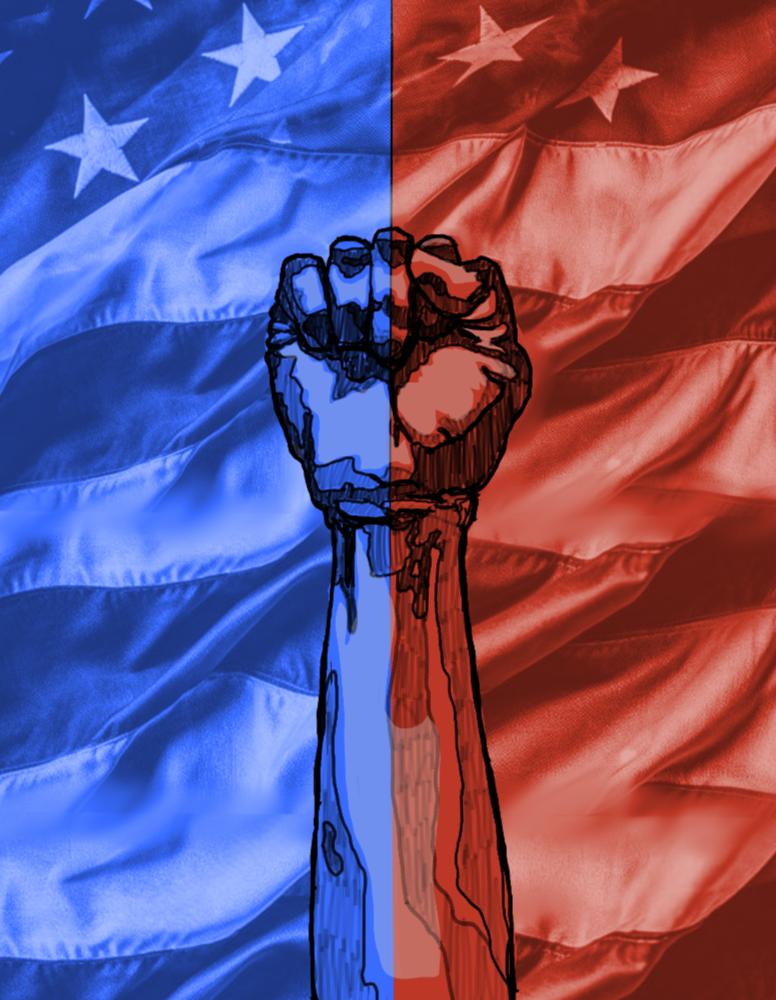
In recent years, many Americans have argued that there has been an increase in national political violence. The divide between the Democratic and Republican parties appears to be more prominent than ever, and the news seems to be filled with individuals publicly encouraging or supporting violent acts.
Some of the most recent examples are the fatal shooting of Renee Good by I.C.E. agents in Minneapolis; the bombing of Pennsylvania Gov. Josh Shapiro’s residence; the murders of Minnesota state senator Melissa Hortman and her husband, Mark Hortman; the assassination of conservative influencer Charlie Kirk; and the three assassination attempts on President Donald Trump.
In the most recent attempt, Cole Allen, a 31-year-old man from California, allegedly attempted to assassinate Trump at the White House Correspondents’ Association Dinner in Washington, D.C on April 25.
In Allen’s infamous manifesto, he stated, “I am no longer willing to permit a pedophile, rapist, and traitor to coat my hands with his crimes.”
During an interview on CBS’s 60 Minutes, the manifesto was quoted by an interviewer, and Trump responded by denying the allegations, calling Allen a “sick person.”
Due to events like these, YouGov polled American youth regarding their thoughts on political violence and published the findings in September of 2025. Similarly, The SIREN surveyed students at Lincoln Park on the same topic. We didn’t follow YouGov’s exact methodology, as we did not ask students their political affiliation, and we interviewed younger age ranges.
In your opinion, is political violence a serious problem today in America?
According to YouGov, when asked if they believe that political violence is a big issue in the United States, only 51 percent of people ages 18-29 considered it an issue. Older age groups logged much higher percentages. By contrast, a Pew Research Group survey of more than 3,000 adults from last September showed that 85 percent of respondents believed politically motivated violence is increasing.
We interviewed 18 Lincoln Park students aged 14 to 18. As a whole, they shared a general belief that political violence is, in fact, a prominent issue today.

Junior media major Joselyn Moore from Beaver Falls said, “It’s terrible. It’s all for no reason, too.”
Other students believe that, as prominent an issue as it is, it’s rarely addressed. “I think, honestly, at this point in time, it’s actually kind of understated how bad it’s gotten,” Jed Wright, a junior music major hailing from Burgettstown, stated. “There’s been violence on both sides, and it’s getting to the point where there probably should be more people talking about it.”
Junior media major Cj Sant from Cranberry Township shared a similar opinion. “I think it’s always been a large issue. I mean, I think it needs to be talked about more. I feel like it’s been shoved aside for a long time.”
However, many pre-law majors we interviewed took other countries into account when forming their opinions. They indicated that political violence may not be as big an issue as some may think.

Mark Veon, a senior pre-law major from Beaver Falls, shared, “I don’t think [political violence] is a serious problem. I don’t think there’s that much political violence in America. I think in other countries there’s probably some big issues, but not here.”
“If political violence wasn’t such an extreme thing in other countries right now, I feel like in America, it would be a bigger topic,” agreed Josie Helbing, a junior pre-law major from Northgate.
Senior pre-law major Ava Rossi from Aliquippa commented, “I think that it has become a more serious problem in recent years, but I do not believe it’s as big a problem in America as it is in other countries.”
Do you think that it is ever justifiable to use violence for political purposes?
“No…at the end of the day, we’re all human, and it is never worth taking another life, even if they were being hypocritical about it and preached for the same thing that killed them,” Camille Estellon, a junior media major from South Fayette, stated. “It still doesn’t make it right.”
Mia Green, a junior media major from Rochester, noted, “Violence: there’s too much of it already in different aspects, not even just political.” Green further explained how violence doesn’t help any cause that people are looking to improve, but rather, creates more issues.
Despite these responses, YouGov reported that 20 percent of people ages 18-29 believe that violence can sometimes be justified in order to achieve political goals.
“Younger and more liberal Americans are more likely than older or more conservative Americans to say political violence can sometimes be justified,” the survey abstract noted.
A few students we interviewed remarked on this trend with points that many may not have considered.

“[It’s justifiable] only in extreme cases like genocides, World War II, [and] World War I,” Jed Wright stated. “But in general, no; there shouldn’t be any violence towards anyone else just because they have a different belief or different way of living their life.”
Levi Frey, a sophomore media major from Oakdale Borough, agreed. “There’s been a few cases where it’s been completely justifiable for violence. Let’s say, World War II– Nazi Germany. That was justified.” Frey went on to say that, in extreme cases of oppression, such as in Nazi Germany, it’s okay to fight against it using force.
Overall, Lincoln Park students we spoke with unanimously agreed that violence stemming from political motives is unjustifiable. However, there can be exceptions, such as extreme cases of oppression or war.
Do you think it’s appropriate for someone to lose their job if they support political violence online–for example, in a social media post?
We added this question on our own, in light of the recent firings of many journalists and other employees due to political reasons.
“I really don’t [think it’s appropriate], just because you’re kind of childish for [doing] that– to, like, fire somebody over something that they believe when it has nothing to do with you, probably,” Joselyn Moore said.
Many students stated that the justification for firings based on political stances online can vary based on circumstances, such as the size of the company and the employee’s actions when sharing their beliefs.
“I think it depends. Like, if I’m working for a smaller, more personal company–[for example], I’m your boss, and you post something, and everybody knows where you work, and maybe that’s just not what our company stands for, then yeah [firing is justifiable],” said Kiara Craker, a freshman writing and publishing major from Monaca.
“But if you’re working for Walmart, and it’s a bigger corporation, then, no, because they’re not standing for anything, and I don’t think you should lose your job over that.”
A recurring theme with the pre-law majors we spoke to was the extent to which the First Amendment protects a person from termination when they publicly take a stance on politics.
Nathan Frederick, a senior pre-law major from Hookstown, initiated this topic. “There’s a whole First Amendment issue there,” he said.
Frederick also mentioned how tone can be hard to pick up online, leading to confusion over whether someone is joking, being sarcastic, or being genuine.
Senior pre-law major Ava Rossi built on this idea.
“Yes [it’s justifiable], because I think that shows a lot about your character, especially if the company values certain things,” she said. “You are free to post that [stuff], but that doesn’t mean the company has to keep you. That’s not in the Constitution. Freedom of speech is not a part of that.”
Teachers’ perspectives: why do adolescents have the opinions that they do?

Lincoln Park students’ opinions contradicted the trends found in the YouGov survey. While the exact causes behind this outcome are unknown, we spoke with some teachers to get an adult perspective.
However, when faced with interview questions on this topic, the majority of the eight teachers we approached preferred not to answer. The two that did answer, though, both shared the belief that social media plays a large part in young people’s opinions, especially when it comes to politics.
“Social media is probably the strongest force that shapes the political preferences/opinions of teens and pre-teens,” stated history teacher Mark Harmon, in an email interview.
When asked why young people are more prone to condone political violence, Mr. Harmon wrote, “Unfortunately, there has been political violence throughout history (ex. assassinations, riots, etc.), but I feel we see more of it today because media, in many forms, is everywhere.”
Zac Cageao, director of the film and broadcast journalism department, shared a similar opinion.
“Social media is poison to a developing brain, even for adults,” Mr. Cageao stated. “News from social media can create mob or herd mentality, which is unhealthy for young people.”
According to Merriam-Webster Dictionary, herd mentality is defined as “(t)he tendency of the people in a group to think and behave in ways that conform with others in the group rather than as individuals.”
In this context, Mr. Cageao referenced algorithms and how social media can detect your beliefs based on videos or posts you’ve liked in the past and provide similar content. This leads to large groups of people who share a similar opinion to be led to the same feeds. In turn, users desperately try to identify with a certain group.
“Like-minded people find each other,” Mr. Cageao explained. “People no longer try to feel like individuals.”
Many others share a similar view on how social media affects political violence, and their opinions were recorded in a Pew Research Center survey published in 2025.
According to the survey, “Sizable shares also mention the media environment: 6% specifically point to social media, and another 6% cite television or other traditional media as factors that contribute to politically motivated violence.”
The question is: if there is such an epidemic, how can youth combat it?
“Educate yourself outside of your use of ChatGPT and social media,” Mr. Cageao suggested.
Mr. Harmon said, “My hope is that young people seek out credible individuals to follow on social media who actually provide unbiased facts and promote free thinking.”
Regardless of students’ political parties or beliefs, Mr. Harmon believes that unbiased research is the most important part of forming any opinion–and helping combat political violence.
“I encourage young people to look at the issues from both sides of the political spectrum,” Mr. Harmon advocated, “and make informed thoughts and opinions based on what they truly believe, rather than what someone else tells them to believe.”
State Representative Rob Matzie’s opinions:

We had the opportunity to speak with State Representative Rob Matzie about the effects of political violence on the country. Rep. Matzie, a Democrat who represents District 16, shared similar opinions as Mr. Harmon and Mr. Cageao, but provided a politician’s perspective about how these events have affected his career and day-to-day life.
“Well, I think it’s unquestionable that the violence has definitely entered into the political arena,” Rep. Matzie said. “Elected officials who you know have to be on guard for any question at any time now have to be on guard for their own safety and, quite frankly, their family’s safety.”
Rep. Matzie shared how his offices recently increased their already-established security measures in response to national political violence.
When confronted with the question of why political violence has seemingly been more recurrent, Rep. Matzie answered, “I think there’s just way too much rhetoric. You have elected leaders, or you have leaders of political parties and affiliations. Folks that are stakeholders supporting one party or another that take it to the extreme and use words that shouldn’t be used by people that are elected officials.
“I think there’s a moral code,” Rep. Matzie added. “Regardless of what the norms are, regardless of what the law is, you’re held to a higher standard as an elected official.”
Rep. Matzie also spoke about youth’s role in violence as a whole and where it originates.
“When it comes to political violence, I think we’ve seen more youth violence,” he stated. “Sadly, it’s become too normal [to] see youth-on-youth violence, whether it’s a school shooting or the threat of a school shooting, somebody caught with a weapon or a note, or a chat was discovered.
“It’s only a matter of time that youth will be a part of a higher end of the equation. When it comes to participating in violence, we have seen some marches and some things that have transpired over the years.”
With the threat of violence in every area of life, Rep. Matzie made his priorities clear.
“My family’s first, always. And keeping my staff safe is paramount. And quite honestly, keeping constituents safe if they’re in my office [is a priority],” Mr. Matzie shared. “We would rather risk on the side of just ‘Hey, call the police and have them come in and talk to somebody, even if it’s just a misunderstanding.’”
Who’s the real villain in this dilemma? According to Rep. Matzie, no single person is to blame.
“I think it’s everybody. I think the rhetoric has just really taken on all different media, whether it’s your phone, traditional television, print media, or magazines,” he said.
There may not be one definitive solution, but like Mr. Harmon and Mr. Cageao, Rep. Matzie suggested taking a look at both sides. “I’ve always tried to be that neutral party and look at all sides of an issue,” he said.
“Find someone who you can trust,” Matzie stated, “not someone who you necessarily always agree with.”