Every few years, the internet rediscovers Carolyn Bessette-Kennedy.
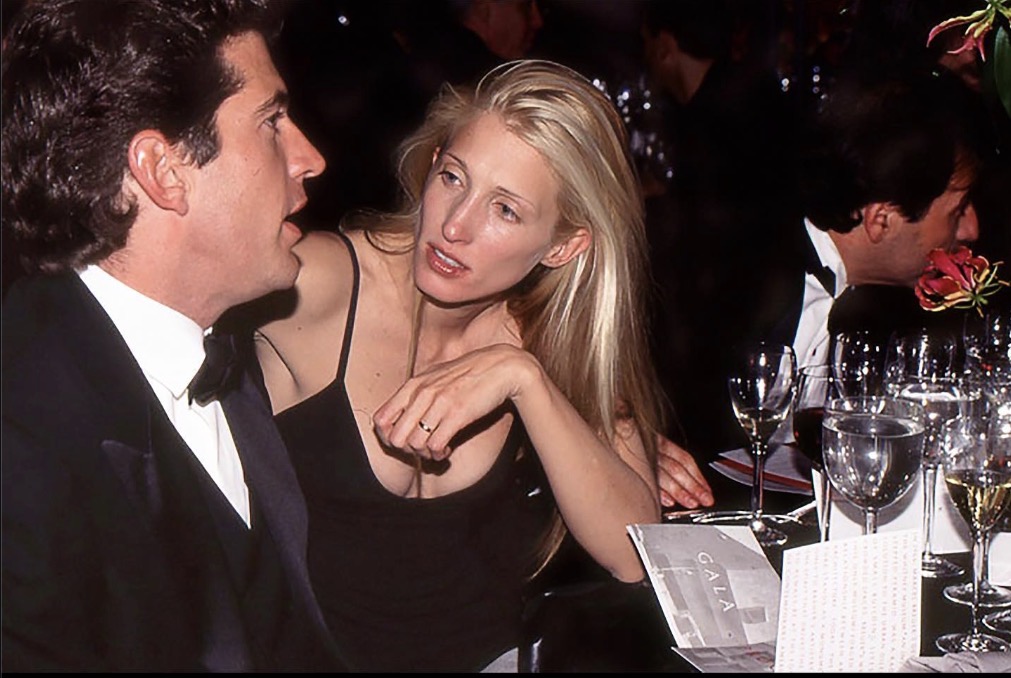
Someone posts a photograph—usually one of the same few. Carolyn walking down a Manhattan street in a long wool coat. Carolyn outside her apartment in narrow sunglasses, hair pulled back with the casual precision of someone who knows exactly how she looks and refuses to make a ceremony of it. Carolyn in a slip dress that feels less like fashion than like the absence of fashion.
And suddenly everyone is talking about her again.
Not just the clothes, though that’s always the entry point. The coats. The bias-cut dresses. The palette of black, cream, camel. The visual language that fashion editors would eventually codify as minimalism and then, decades later, rebrand as quiet luxury. Carolyn has become a kind of aesthetic shorthand. A mood board before mood boards.
But the clothes aren’t really the reason she has captured the spotlight.
What people are responding to—what they’re always responding to—is the feeling that we never quite knew her.
In a culture built on the illusion of intimacy, Carolyn Bessette-Kennedy remains stubbornly opaque. She didn’t narrate her life in interviews. She didn’t build a public persona through confession. There are thousands of photographs of her and almost no sense, even now, of what she thought about any of it.
Which makes her unusually difficult to categorize.
And that difficulty seems to bother people.
You can watch the impulse happen almost in real time whenever her name resurfaces. The internet begins trying to decide what she “was.” The cool girl. The minimalist icon. The icy wife. The reluctant celebrity. The woman who married into Camelot and couldn’t quite bear the glare.
It’s striking how quickly the conversation shifts from fascination to diagnosis. A woman who didn’t give interviews becomes aloof. A woman who doesn’t smile at paparazzi becomes cold. A woman who declines to narrate her own life becomes, somehow, responsible for the discomfort created by that silence.
The public, it turns out, really hates a vacuum.
Carolyn entered the American imagination through one of the most mythologized doorways possible: marriage to John F. Kennedy Jr., the closest thing the country had to a political prince. The wedding in 1996 was instantly absorbed into the long Kennedy narrative of glamour and tragedy. For the public, the story was simple. America’s most eligible bachelor had found his bride.
But Carolyn never behaved quite the way that role required.
She had worked in fashion public relations at Calvin Klein before she met John, which meant she understood celebrity culture from the inside. She knew how images were constructed, how narratives were fed to the press, how personalities were shaped into digestible archetypes. And she seemed to have little interest in participating.
She avoided interviews almost entirely. She didn’t cultivate the kind of public warmth that makes journalists feel rewarded. Photographs of her often captured a small defensive choreography: a hand raised slightly toward the camera, a quick pivot of the body, an expression that suggested both irritation and endurance.
None of this was dramatic. She wasn’t staging some grand rebellion against fame. She simply seemed uninterested in becoming legible to strangers.
Which, paradoxically, made strangers obsessed with her.
There’s something about an unknowable woman that invites projection. Without a clear narrative, the public begins supplying one. The blank spaces become irresistible. Personality traits are inferred from body language. Entire emotional landscapes are constructed from photographs taken in the middle of a walk down the street.
In Carolyn’s case, the projections often revealed more about cultural expectations than about her.
Women in public life are generally expected to perform accessibility. Warmth. Gratitude for the attention. A willingness to translate themselves. When that performance is withheld, the absence doesn’t read as neutrality—it reads as attitude.
So Carolyn became a Rorschach test.
To some people she was impossibly chic, the embodiment of a certain New York restraint that made everyone else look like they were trying too hard. To others she seemed severe, closed off, maybe even unhappy. The same qualities that produced her allure—her reserve, her composure, the sense that she was moving through the spectacle rather than embracing it—were also the qualities that unsettled people.
She refused to help the public decide who she was.
And that refusal still feels strangely radical.
It’s easy to forget how different celebrity culture looked in the 1990s. There were paparazzi and tabloids, yes, but there was still the possibility of partial privacy. Public figures could remain slightly out of focus. Mystery was still structurally possible.
Today the entire system runs on revelation. The algorithm rewards disclosure. Personalities are built through constant self-definition—statements, posts, interviews, explanations. The modern celebrity economy depends on the steady translation of a private life into consumable narrative.
Carolyn never entered that economy.
Which means she exists now almost like a relic from a parallel timeline: a public figure who remained, stubbornly, private.
That privacy is often mistaken for effortlessness. Looking at photographs of her now, it’s tempting to believe she simply existed in a permanent state of cool—naturally elegant, naturally composed, naturally immune to the anxieties that drive everyone else.
But effortlessness is one of the most persistent myths attached to women. The idea that some women glide through life untouched by the labor of self-presentation is both seductive and quietly punishing. If elegance appears natural, then anyone who looks like they’re trying must be failing.
Carolyn’s style has been absorbed into that mythology. The slip dresses and black coats have become symbols of a kind of aesthetic purity, the fantasy that the right combination of restraint and good tailoring might allow a woman to transcend the chaos of cultural expectation.
But the photographs tell a more complicated story if you look closely. The tension in her posture when cameras surround her. The quickness of her stride. The way she shields her face with her hand.
What we read as cool might also have been exhaustion.
And yet the fascination persists, because Carolyn never stepped forward to clarify any of it. She never gave the interview that would collapse the speculation. She never wrote the memoir that might have replaced the projections with something more concrete.
Her life ended suddenly in 1999, in the plane crash that killed her, John, and her sister Lauren off the coast of Martha’s Vineyard. She was thirty-three. The story stopped before it had the chance to evolve.
Which means Carolyn remains permanently unresolved.
That unresolved quality is part of why she continues to haunt the cultural imagination. She represents a version of womanhood that feels increasingly rare: someone visible enough to be iconic but private enough to remain partially unknowable.
In the end, the allure of Carolyn Bessette-Kennedy may have less to do with her than with the way we react to women who refuse to define themselves publicly.
When a woman doesn’t provide the narrative, society rushes to write one anyway.
Cold. Elegant. Difficult. Perfect. Misunderstood.
The categories say more about us than they ever did about her.
And maybe that’s the real reason we keep returning to those photographs of her walking through New York, coat pulled tight, sunglasses on, moving quickly past the cameras.
We’re still trying to decide who she was.